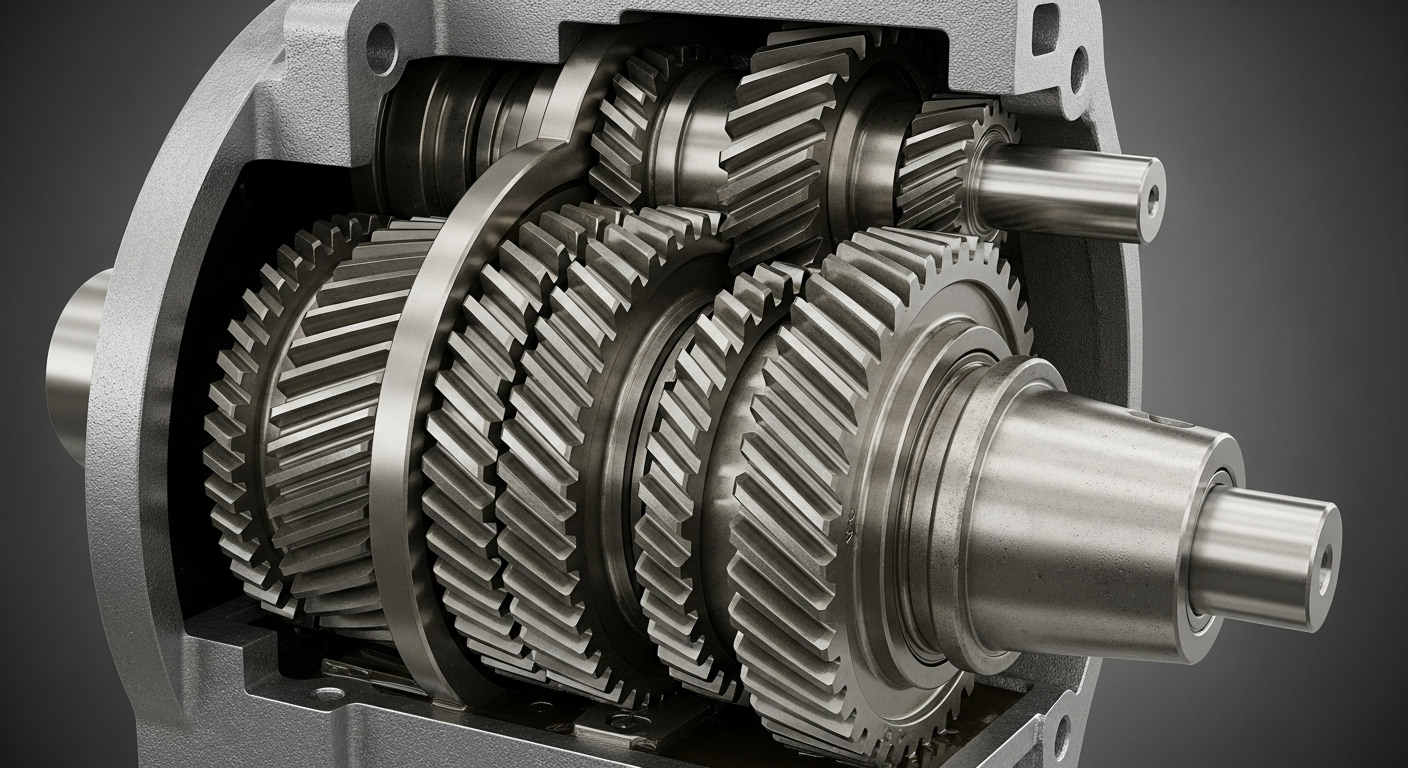
The helix angle determines how steeply a spiral climbs around a cylinder – and it’s one of the most critical measurements in mechanical design. This single angle affects everything from how much force a screw can generate to how smoothly your car’s transmission shifts gears.
Think about the threads on a bolt. If those threads wrap around at a gentle angle, you’ll need more turns to tighten it, but you’ll generate tremendous clamping force. Make that angle steeper, and the bolt moves faster with each turn but loses mechanical advantage. That’s helix angle at work.
Whether you’re designing cutting tools, gears, or conveyor screws, getting this angle right makes the difference between a machine that runs efficiently for years and one that fails on day one. Let’s break down exactly what helix angle is and how to choose the right one for your application.

What Is A Helix
A helix is a three-dimensional spiral shape that curves around a central axis at a constant angle. Picture a spring or the threads on a screw – that’s a helix in action.
You encounter helixes every day without realizing it. The spiral staircase in a parking garage, the grooves on a drill bit, and even the DNA in your cells all follow this same fundamental shape.
What makes a helix special is its uniform progression. As it wraps around its axis, it rises at the same rate with each turn, creating a smooth, predictable path that engineers can calculate and control precisely.
Geometric Features of a Helix
A helix has several key geometric characteristics that define its shape and behavior:
- Pitch: The vertical distance the helix rises in one complete turn around the axis. Think of it as how far up you’d travel walking once around a spiral staircase.
- Lead: The axial distance covered by one complete helical thread (for multi-start helixes, this equals pitch times the number of starts).
- Diameter: The width of the cylinder the helix wraps around, measured from the centerline.
- Direction: Helixes can be right-handed (clockwise when viewed from above) or left-handed (counterclockwise).
- Number of Starts: Single-start helixes have one spiral path, while multi-start helixes have multiple parallel paths wrapped around the same axis.
What is Helix Angle
The helix angle is the angle between the helix spiral and a plane perpendicular to the axis of rotation. It determines how steeply the spiral climbs as it wraps around the cylinder.
Imagine unwrapping the helix and laying it flat. The helix angle is the angle the unwrapped spiral makes with the horizontal – a small angle means a gentle climb, while a large angle means a steep ascent.
This angle directly affects how forces transfer through the helix. In gears and screws, it controls everything from cutting efficiency to load distribution, making it one of the most critical design parameters in mechanical engineering.
Mathematical Formulation of Helix Angle
The helix angle (α) can be calculated using this simple formula: tan(α) = Lead / (π × Pitch Diameter).
Let’s break this down with real numbers. If you have a screw with a lead of 5mm and a pitch diameter of 10mm, your helix angle would be: tan(α) = 5 / (π × 10) = 0.159, which gives you α = 9.04 degrees.
For gears, you might see a slightly different formula: tan(α) = (π × Module × Number of Teeth) / Lead. The principle remains the same – you’re measuring the relationship between the axial movement and the rotational movement.
Engineers often work with standard helix angles. Most power screws use angles between 5° and 30°, while helical gears typically range from 15° to 45°.
What is the Difference Between High Helix Angles and Low Helix Angles
Low helix angles (under 15°) create more axial thrust but provide better mechanical advantage. They’re like walking up a gentle ramp – you travel farther horizontally but need less effort to climb.
These shallow angles excel in applications requiring high torque transmission or self-locking properties. Lead screws in machine tools often use angles around 5-7° because they won’t back-drive under load.
High helix angles (over 30°) move material or motion more quickly but require more power. Picture a steep ramp – you climb faster but work harder.
Drill bits use high helix angles (typically 25-35°) to evacuate chips rapidly from the cutting zone. The steep spiral acts like a conveyor belt, pulling debris up and out of the hole.
The trade-off is always between speed and force. Low angles give you mechanical advantage but slow movement, while high angles provide rapid motion at the cost of increased power requirements.
How to Choose Helix Angle
Selecting the right helix angle requires balancing multiple factors based on your specific application:
- Load Requirements: Heavy loads need lower helix angles (5-15°) for better mechanical advantage and reduced stress on components.
- Speed Needs: High-speed applications benefit from steeper angles (25-45°) to maximize axial movement per rotation.
- Material Being Processed: Soft materials allow steeper angles, while hard materials require shallower angles to prevent tool breakage.
- Self-Locking Requirements: Applications needing to hold position without power should use angles below 5-7° to ensure self-locking.
- Noise and Vibration: Helical gears with 15-25° angles run quieter than straight-cut gears, making them ideal for automotive transmissions.
- Manufacturing Constraints: Steeper angles can be harder to machine accurately and may require specialized equipment.
- Efficiency Goals: Angles between 15-30° typically offer the best balance of efficiency and performance for most power transmission applications.
Start by identifying your primary requirement – is it holding power, speed, or smooth operation? Then adjust the angle based on secondary factors like noise levels and manufacturing capabilities.
FAQs
What is the most common helix angle for drill bits?
Most general-purpose drill bits use a helix angle between 25° and 35°. This range provides good chip evacuation for common materials like steel and aluminum while maintaining reasonable cutting forces.
Can a helix angle be negative?
Yes, a negative helix angle means the spiral runs in the opposite direction. This is common in some specialized cutting tools where you need to push chips downward rather than pulling them up.
How does helix angle affect gear noise?
Helical gears with angles between 15° and 25° run much quieter than straight-cut gears because the teeth engage gradually rather than all at once. The sliding contact distributes the load and reduces impact noise.
What helix angle prevents back-driving in screws?
Screws with helix angles below 5-7° typically self-lock and won’t back-drive. This happens when the friction force exceeds the component of load trying to rotate the screw backward.
How do I measure helix angle on an existing part?
You can measure helix angle by marking one complete turn of the helix, measuring the lead distance, then using the formula: helix angle = arctan(lead / π × pitch diameter). Digital angle gauges can also measure directly on the part.
Does helix angle affect tool life?
Yes, lower helix angles generally increase tool life because they reduce cutting forces and heat generation. However, they may cause chip evacuation problems in deep holes, which can also damage tools.