Read “module 4” off a replacement quote and you already know the tooth size — a circular pitch of about 12.6 mm (π × 4), bigger teeth, more contact area, more torque the set carries than a module-2 unit. Hand that same gear a module-3 mate, though, and it will not mesh, no matter how perfectly the ratio lines up.
That single number is the most useful thing on a gear nameplate, and most buyers walk past it. Module fixes tooth size, and tooth size decides how much load a gearset carries and whether a replacement will drop in and mate.
Master what the number tells you and you can size, sanity-check, and match an industrial reducer without ever touching a cutter formula.
What a Module Tells You About a Gear
Module is the metric unit of gear tooth size, calculated as m = d / z — the pitch diameter divided by the number of teeth. A gear with a 60 mm pitch diameter and 30 teeth has a module of 2, meaning each tooth and its space occupy about 6.28 mm (π × 2) along the pitch circle.

Rearrange the same relationship and it reads forward: d = m × z. Multiply module by tooth count and you get the pitch diameter, which tells you how large a gear is before you ever measure it. With the pitch diameters of two mating gears, the gear center distance calculator gives you their center distance.
So “module” is shorthand for tooth size in millimeters. A module-4 gear has teeth roughly twice the size of a module-2 gear, and that difference governs strength, mesh, and fit — it is the gear’s most load-bearing specification, not a label printed for reference.
Why a Bigger Module Means a Stronger Gear
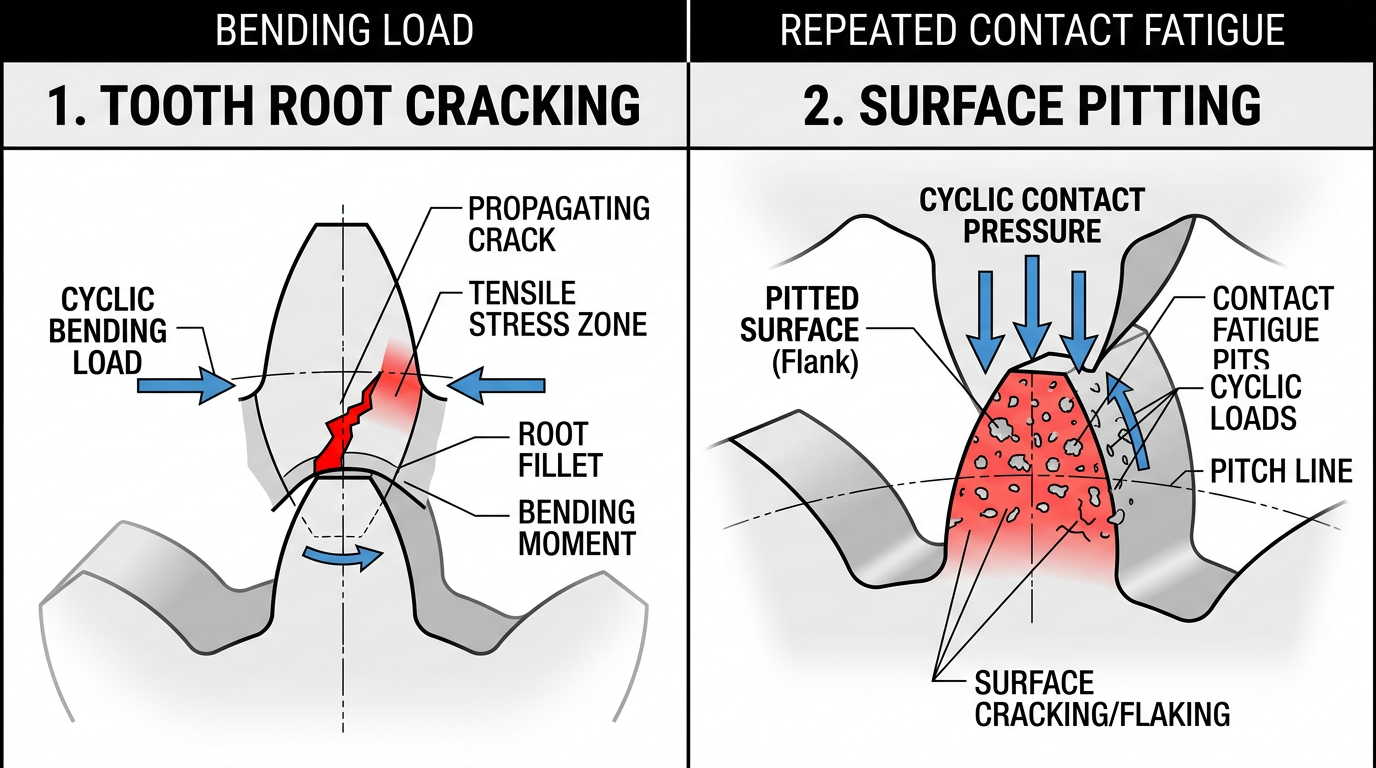
A larger module means physically larger, thicker teeth that carry more load. In the Lewis bending equation engineers use to rate gear strength, σ = Wt / (F × m × Y), the module m sits in the denominator. Doubling the module roughly halves the tooth bending stress, and the allowable load scales straight up with module.

Module is the first thing I check when a customer asks whether a smaller, cheaper-looking reducer will survive their duty. Step a 20 mm face from module 2 up to module 4 and the same width carries far more, because the tooth is twice the size with proportionally more material resisting the bending force.
The trade-off is size: a bigger module on the same tooth count means a bigger gear, and a bigger reducer. When a duty pushes the torque rating, the answer is usually a larger module — the same logic behind stepping up to a heavier worm or helical gearbox family.
Read a small module on a high-torque application as a warning, not a bargain.
When Two Gears Will Actually Mesh
Two gears mesh only if they share the same module — and, for helical and worm sets, the same pressure angle and tooth profile. A replacement with a matching gear ratio but a different module will not run, because the teeth are physically the wrong size to interlock. The ratio matching is a coincidence, not a guarantee of fit.

A module mismatch is the most expensive mistake I see in replacement sourcing. A buyer finds a gear with the right tooth count and the right reduction, orders it, and discovers at installation that the teeth are coarser or finer than the mate.
For a sealed reducer, a “drop-in equivalent” is only equivalent if the internal gearing matches module and pressure angle, not just the catalog ratio. Matching the unit by series — confirming the replacement is the same family of worm gearbox or helical reducer — sidesteps the guesswork, because the gearing inside is built to the same module set.
Worm and helical spec sheets sometimes list two values, a normal and a transverse module. For a replacement, confirm the same value in the same plane the original used, plus the pressure angle.
Reading Metric Module vs Diametral Pitch on a Spec Sheet
Metric module and diametral pitch are two unit systems for the same thing — tooth size — and they convert through the constant 25.4, since one inch equals 25.4 mm. Module equals 25.4 divided by diametral pitch (DP), and DP equals 25.4 divided by module.
In practice that means module 2 is about 12.7 DP, module 4 is 6.35 DP, and module 1 is 25.4 DP.
You meet both systems the moment you compare imported and domestic equipment. Module is the metric specification used across Europe and Asia, defined in millimeters under ISO 54; diametral pitch is the inch-based system common on US-spec gearing under AGMA 910. One quote may read “module 3” and another “8.47 DP” for nearly the same tooth.
The conversion is a comparison aid, not a fit guarantee. It lets you line up two quotes on the same scale, but a metric gear and an inch gear still will not reliably mate. Pressure angle and tooth profile differ between the two ecosystems even when the converted pitch looks matched.
Standard Module Sizes and How to Spot a Custom Gearset
Standard metric modules follow a defined series under ISO 54 and ISO 701: 0.5, 0.6, 0.8, 1, 1.25, 1.5, 2, 2.5, 3, 4, 5, 6, 8, 10, 12, 16, and 20 mm. The standard splits these into a preferred Series 1 and a second-choice Series 2.
Preferred values exist because tooling and replacement parts for them are available worldwide. Run a quoted module against this series and you have an instant sanity check.
A value that lands on the list — module 3, module 5 — is a stock-friendly size you can source without long lead times. A value off the series, like 3.7, flags a non-standard custom gearset cut to a special module.
A custom module is not wrong, but it changes the sourcing picture: single-source parts, longer lead times, and a higher chance you are tied to one supplier for the life of the equipment. Check a nameplate value against the standard series first — it tells you whether you are looking at a commodity gear or a captive one.
Where Buyers Go Wrong With Module
The most common mistake is treating any gear of the same ratio — or any “equivalent” reducer — as a drop-in when the modules differ. A matching reduction does not make two gears interchangeable; module and pressure angle have to match first, or the teeth simply will not mesh.
Confirm the module value, the unit system, and the pressure angle against the original before treating a replacement as a substitute.
Read forward from the number, not just off it. A module tells you the tooth size, the tooth size sets the relative load capacity, and a shared module is the precondition for fit.
Those three reads give a buyer everything needed to spec, sanity-check, and match an industrial reducer — and a clear reason to ask one more question whenever a value falls off the standard series.