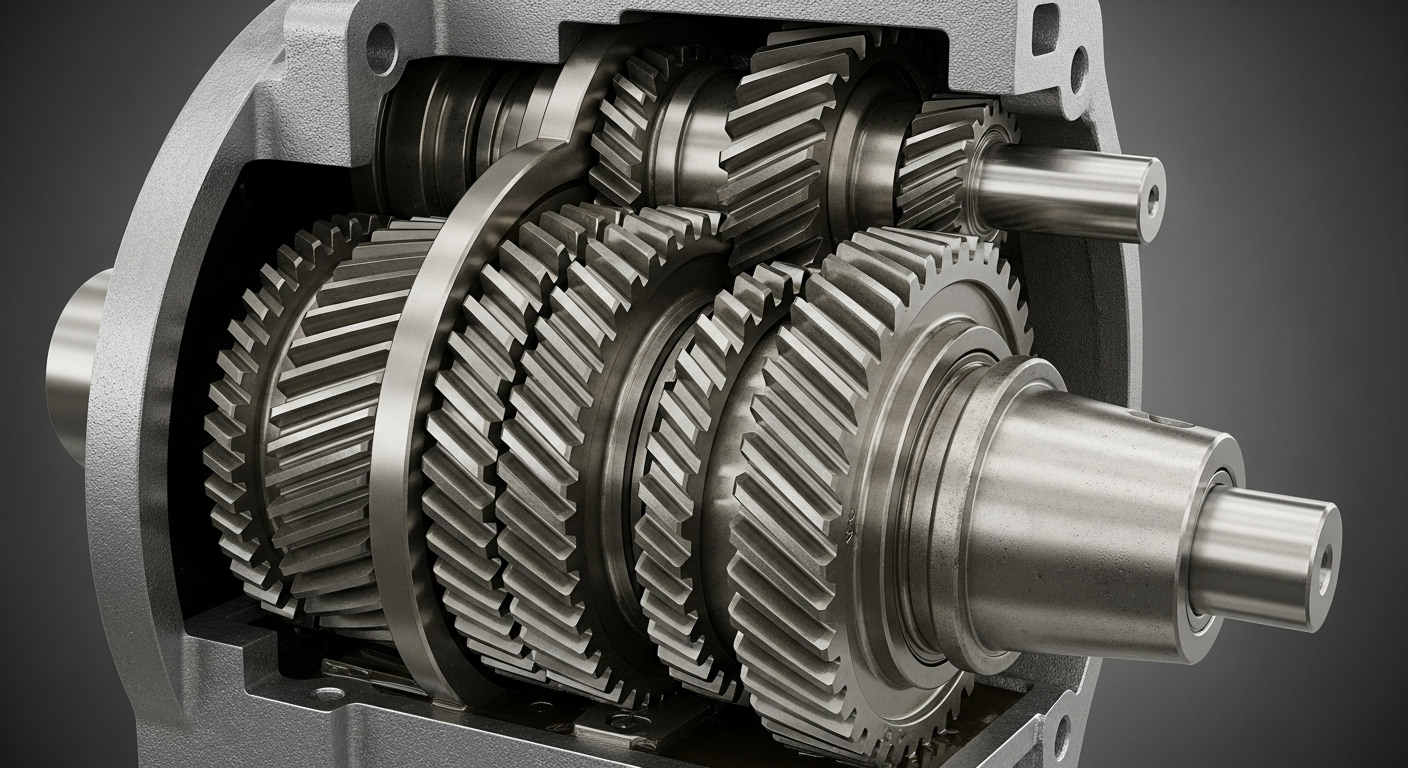
In the world of machinery, gearboxes serve as the unsung heroes of power transmission. Among the various types of gearboxes, the 2 speed gearbox stands out for its ability to provide two distinct speed ratios, offering flexibility and efficiency in a wide range of applications.
This blog post delves into the intricacies of 2 speed gearboxes, exploring their working principles, components, and types of shifting mechanisms. We will also discuss the advantages and disadvantages of using 2 speed gearboxes and compare them with other gear systems to provide a comprehensive understanding of their role in the machinery industry.

What Is a 2 Speed Gearbox
A 2 speed gearbox is a mechanical transmission device that provides two distinct gear ratios between the input and output shafts. This allows the gearbox to change the speed and torque delivered from the power source, typically an electric motor or internal combustion engine, to the driven equipment. The ability to switch between two different gear ratios enables the system to optimize performance, efficiency, and power delivery across a wider range of operating conditions compared to single-speed gearboxes.
2 speed gearboxes find applications in various machinery and vehicles where the demands on the power transmission system vary significantly depending on factors such as load, speed, or terrain. The two gear ratios are strategically selected to provide an optimal balance between low-end torque for starting or climbing and high-end speed for efficient cruising or rapid movement.
How 2 Speed Gearboxes Work
The functioning of a 2 speed gearbox relies on the interaction between gears, shafts, and a shifting mechanism. The input shaft, connected to the power source, drives a set of gears that mesh with corresponding gears on the output shaft. The gearbox contains two sets of gears, each providing a specific gear ratio. The gear ratio determines the relationship between the rotational speeds of the input and output shafts.
To change between the two gear ratios, a shifting mechanism is employed. The most common types of shifting mechanisms in 2 speed gearboxes are centrifugal clutches, dog clutches (also known as slider gears), and shoe-type clutches. These mechanisms engage or disengage specific gear sets, allowing the power to be transmitted through the desired gear ratio.
When the gearbox is in the low-speed gear, the input shaft’s rotational speed is reduced, and the torque is increased at the output shaft. This configuration is suitable for starting from a standstill, climbing inclines, or handling heavy loads. Conversely, when the gearbox is shifted into the high-speed gear, the input shaft’s rotational speed is multiplied, resulting in higher output speed but reduced torque. This gear ratio is ideal for high-speed operation, cruising, or rapid movement of lighter loads.
The shifting between gear ratios can be controlled manually, automatically based on predefined speed or load thresholds, or through external control systems. In automatic shifting systems, centrifugal clutches or one-way bearings are commonly used to facilitate seamless transitions between gears without manual intervention.
Components of 2 Speed Gearboxes
Two-speed gearboxes consist of several key components that enable them to provide two distinct gear ratios:
- Input Shaft: The input shaft is connected to the power source, such as an electric motor or engine. It transfers the input power to the gearbox.
- Output Shaft: The output shaft is connected to the driven equipment, such as a conveyor or pump. It delivers the power from the gearbox at the selected gear ratio.
- Gear Sets: Two-speed gearboxes typically contain two or more sets of gears with different tooth counts. These gear sets provide the different gear ratios for low and high-speed operation.
- Clutch Mechanism: A clutch mechanism is used to engage and disengage the gear sets. It allows the gearbox to switch between the low and high-speed gear ratios. .
- One-Way Bearing: Some two-speed gearboxes incorporate a one-way bearing. This bearing allows the input shaft to rotate freely in one direction while locking in the opposite direction. It helps to ensure smooth and efficient gear shifting.

Types of Shifting Mechanisms
Two-speed gearboxes employ various types of shifting mechanisms to switch between gear ratios:
Centrifugal Clutch
Centrifugal clutches use centrifugal force to automatically shift gears based on the rotational speed of the input shaft. As the speed increases, the centrifugal force causes the clutch shoes to engage with the drum, activating the high-speed gear ratio. When the speed decreases, the clutch disengages, reverting to the low-speed gear ratio.
Dog Clutch (Or Slider Gear)
Dog clutches, also known as slider gears, use a sliding collar with dog teeth that engage with corresponding teeth on the gears. The collar is moved axially to engage or disengage the gears. This type of clutch provides positive engagement and is commonly used in manual shifting mechanisms.
Shoe-Type Clutch
Shoe-type clutches consist of a set of shoes or friction pads that expand outward to engage with a drum or ring. The engagement is typically controlled by a centrifugal or hydraulic actuator. When engaged, the shoes lock the input and output shafts together, transmitting power through the selected gear ratio.
Advantages of 2 Speed Gearboxes
Improved Efficiency
Two-speed gearboxes offer improved efficiency compared to single-speed systems. The ability to switch between high and low gear ratios allows the system to optimize power transmission based on the operating conditions. This results in reduced energy consumption and enhanced overall efficiency.
Increased Torque Output
The low gear ratio in a two-speed gearbox provides increased torque output. This is particularly beneficial in applications that require high starting torque or need to overcome significant loads. The higher torque capacity enables the system to handle demanding tasks more effectively.
Extended Speed Range
With two gear ratios available, two-speed gearboxes offer an extended speed range compared to single-speed systems. The high gear ratio allows for faster operation, while the low gear ratio provides increased torque. This versatility makes two-speed gearboxes suitable for applications that require both high-speed and high-torque capabilities.
Smooth Operation
Two-speed gearboxes often incorporate clutch mechanisms that enable smooth transitions between gear ratios. This results in smoother operation and reduced shock loads on the system components. Smooth gear shifting minimizes wear and tear, leading to increased system durability and reliability.
Disadvantages of 2 Speed Gearboxes
Increased Complexity
Compared to single-speed systems, two-speed gearboxes have a more complex design. The additional components, such as clutch mechanisms and multiple gear sets, increase the overall complexity of the system. This complexity can lead to higher manufacturing costs and potentially more maintenance requirements.
Added Weight and Size
The inclusion of additional components in a two-speed gearbox results in increased weight and size compared to single-speed systems. The extra weight can be a disadvantage in applications where lightweight design is crucial, such as in aerospace or automotive industries. The larger size may also pose challenges in space-constrained environments.
Potential for Wear and Tear
The presence of multiple gear sets and shifting mechanisms in a two-speed gearbox introduces more points of potential wear and tear. The engaging and disengaging of gears during shifting can cause increased friction and stress on the components.
Applications of 2 Speed Gearboxes
Industrial Machinery
Two-speed gearboxes find extensive use in industrial machinery, such as conveyors, mixers, and pumps. The ability to switch between high and low gear ratios allows for optimized operation based on the specific requirements of the machinery. This flexibility enhances productivity and efficiency in industrial settings.
Electric Vehicles
Two-speed gearboxes are increasingly being employed in electric vehicles. The low gear ratio provides high torque for accelerating from a standstill, while the high gear ratio enables efficient high-speed cruising. This dual-speed capability improves the overall performance and range of electric vehicles.
Wind Turbines
In wind turbine applications, two-speed gearboxes are used to optimize power generation. The low gear ratio is engaged during low wind speeds to maximize torque and ensure efficient power capture. As the wind speed increases, the gearbox switches to the high gear ratio, allowing the turbine to operate at higher rotational speeds and generate more power.
Heavy Equipment
Two-speed gearboxes are commonly used in heavy equipment, such as construction and mining machinery. The low gear ratio provides high torque for heavy lifting and digging operations, while the high gear ratio allows for faster travel speeds between job sites. This versatility enhances the productivity and efficiency of heavy equipment operations.
Comparison with Other Gear Systems
Single-Speed Systems
Single-speed gear systems, as the name implies, operate at a fixed gear ratio. This means that the input and output shafts maintain a constant speed relationship, regardless of the operating conditions. While single-speed systems are simpler and more cost-effective than two-speed gearboxes, they have limitations in terms of flexibility and efficiency.
In applications where the load or speed requirements vary significantly, single-speed systems may not provide optimal performance. They cannot adapt to changing conditions, which can result in reduced efficiency and increased wear on the components. Additionally, single-speed systems may require a larger motor or engine to accommodate the full range of operating conditions, as they cannot shift gears to optimize torque or speed.
Continuously Variable Transmissions (CVTs)
Continuously variable transmissions (CVTs) offer a different approach to gear ratio adjustment. Unlike two-speed gearboxes, which have discrete gear ratios, CVTs provide an infinite number of gear ratios within a given range. This allows for seamless and stepless variation of the gear ratio, enabling the system to maintain optimal engine or motor speed for a given load.
CVTs typically consist of a belt or chain that runs between two variable-diameter pulleys. By adjusting the width of the pulleys, the effective diameter changes, resulting in a change in the gear ratio. This allows CVTs to provide smooth acceleration and maintain optimal engine or motor efficiency across a wide range of speeds.
However, CVTs have some limitations compared to two-speed gearboxes. They are generally less efficient than fixed-gear systems due to the energy losses associated with the belt or chain and the hydraulic or electronic control systems. CVTs also have a limited torque capacity, making them less suitable for heavy-duty applications. Additionally, the complexity of CVTs can result in higher manufacturing and maintenance costs compared to two-speed gearboxes.